Organic Farm
Enjoy a true pampering on our organic farm
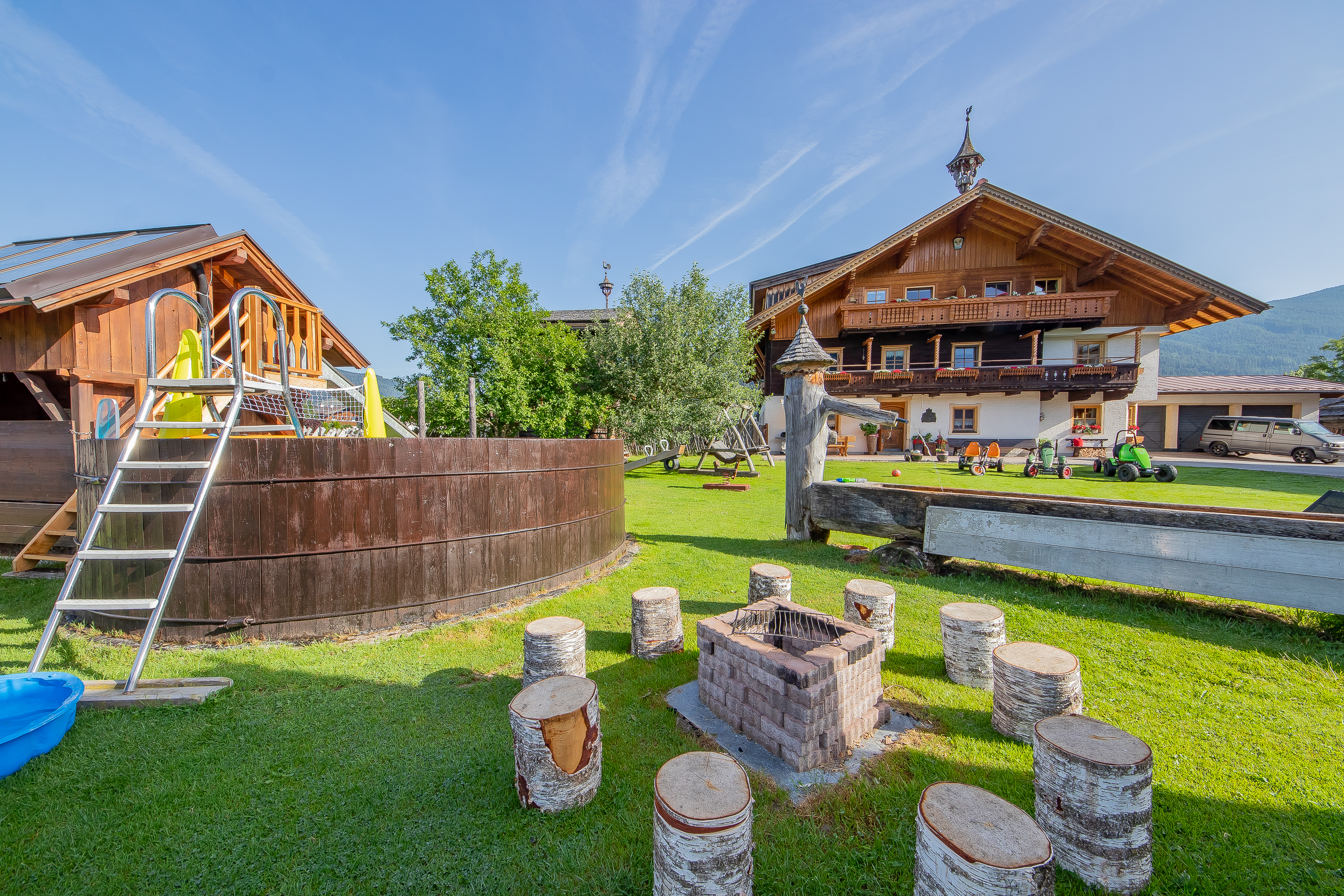
Enjoy a genuine country lifestyle on an authentic Salzburg farm, at an elevation of 1120 metres above sea level. Check out this article published in the "Salzburger Nachrichten" on 13 October 2001:
Contact with Cows:
Regular contact with cows, pigs, sheep and poultry - in other words, livestock on the farm - protects children from later occurrences of allergies and allergy-related ailments, including asthma. This has now been shown in a study group run by Professor Josef Riedler of Salzburg Children's Hospital (LKH). This scientific work was first presented some two years ago at the European Lung Congress in Madrid. Only now, however, has it been published on a wider scale, this time in the British journal "The Lancet" (Vol. 258, p. 1129).
A total of 2283 children ages eight to ten completed a questionnaire about their lifestyles and their frequency of allergic symptoms. These studies were conducted in several Austrian provinces and within the framework of an international network. For 1137 of the children, physicians participating in the scientific study also conducted a "skin-prick test" for possible hypersensitivity as an indication of an allergy.
During their analysis of data, the experts came upon astonishing results. "As we reviewed the data, it turned out that those children who lived on a farm were three times less likely to have hay fever than those children from an urban setting", so the findings read. According to the results, only 3.1 percent of children from a rural environment suffered from hay fever. In contrast, for urban children the result was 10.3 percent. The difference was even greater when it came to allergic asthma: only 1.1 percent of children from farms reported symptoms, whereas for urban children the result was 3.9 percent.
These results could be further confirmed through the skin test: In this case - through sample skin exposure to allergies - hypersensitivity was documented in 32.7 percent of urban children. For children from farms, this was only true in 18.8 percent of cases.
Riedler and his co-authors also documented the protective effects in further analysis. They investigated the effects of contact between children and livestock regardless of where they permanently resided - be that in the city or country - upon occurrences of allergies. Result: Those girls and boys from the city who came into regular contact with such animals, demonstrated similarly reduced propensities for allergies as those of children from farms.
Riedler ascribes the protective effects of rural life with regard to allergies to the "development of a tolerance" due to frequent contact with germs and a wide variety of antigens. Several scientific studies of recent years have shown that, those children who grow up in "clinically clean" households, have a greater tendency for allergies. This applies also to only-children, while those children with many siblings, or with early contact with numerous children of the same age (at nursery schools, etc.), are much less likely to show allergic reactions.
Experts believe that allergies, and related ailments such as asthma, are on the rise in western industrialized countries because the immune system of people in clean conditions, due to a "lack" of natural stimuli, produces reactions directed against, or exaggerated immune responses within their own body.